
Trump Is in China Right Now — Here’s What Could Come Out of It
Trade deals, Taiwan, Iran, AI, and a state banquet. The most consequential summit of 2026 is happening as you read this.
Trump’s visit to China is happening right now — today, May 13, 2026. President Donald Trump has landed in Beijing for a multi-day state visit that carries global consequences as the world’s two largest economies negotiate their relationship at the highest level. And the stakes could not be higher. Trump’s visit to China comes loaded with an agenda covering trade, Iran, Taiwan, and artificial intelligence — and the outcomes could reshape the world order for decades to come.
Here’s a full breakdown of what could come out of it.
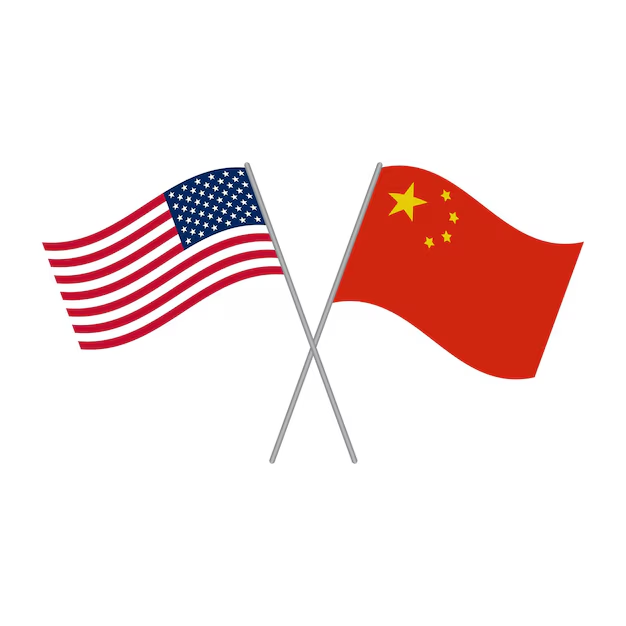
1. A Trade Deal — Or at Least the Appearance of One
The original reason this trip was put on the calendar was trade. When this visit was put on the books last fall, the focus was on keeping the trade truce between the two countries going.
Experts are anticipating that Trump and Xi may announce large Chinese orders of American planes and soybeans when the meetings conclude. A potential “US-China Board of Trade” to manage what has been a challenging relationship between the two countries is also reportedly on the table.
For Trump, a splashy trade announcement is the most politically useful outcome he can bring home. Expect a press conference with big numbers — orders worth hundreds of billions of dollars — that he can headline back in the US as a win for American workers and farmers.
2. Iran and the Strait of Hormuz
When it comes to Trump’s visit to China, the Iran war is the elephant in the room — and arguably the most urgent item on the agenda.
Along the streets of Beijing, residents cast wary eyes toward Trump’s visit, and what many believe will be his most urgent request of Xi: help reopening the Strait of Hormuz. The US conflict with Iran has choked off one of the world’s most critical oil shipping lanes, and China is the largest consumer of Iranian oil. It has a direct economic interest in seeing the blockade end.
The ceasefire with Iran is on “massive life support,” as Trump described it, and the conflict remains in an unsteady and uncertain holding pattern. Meanwhile, Iran’s foreign minister Abbas Araghchi traveled to Beijing just days before the summit, underscoring close ties between China and Iran.
China is uniquely positioned to pressure Tehran. Whether Xi is willing to use that leverage — and what he would demand from Trump in return — is the most unpredictable and consequential question hanging over the entire summit.
Learn more about the Strait of Hormuz and global oil supply
3. Taiwan — The Most Dangerous Topic on the Table
Trump’s visit to China takes a dangerous turn when the conversation shifts to Taiwan
On May 11, Trump announced he would have a discussion with Xi on the matter of arms sales to Taiwan, breaking with the Six Assurances — the long-standing US commitments to Taiwan that have underpinned cross-strait stability since 1982. That announcement alone sent alarm bells ringing across Taipei and Washington’s foreign policy establishment.
Some US officials have expressed concern that Trump is walking into a meeting where Xi holds the cards — and that the Chinese leader may use that leverage to get what he wants on Taiwan. Trump himself told reporters: “He’ll bring up Taiwan, I think, more than I will” — a line that did little to reassure Taiwan’s allies.
Some experts note that the ongoing Iran war could give China greater leverage when dealing with Trump, given that the US has diverted resources away from South Korea and Japan to the Middle East — resources that would be critical in any conflict over Taiwan.
Any signal from Trump that the US is softening its commitment to Taiwan’s defense would be a massive geopolitical win for Beijing — and a potentially catastrophic blow to the rules-based order in the Indo-Pacific.
4. AI and Technology
Trump’s visit to China puts artificial intelligence front and center on the global stage. Trump and Xi are also expected to discuss AI technology, at least to establish “some channels of deconfliction.” The presence of Nvidia’s Jensen Huang — whose chips sit at the center of the global AI arms race — is a signal that technology policy will be a live issue at the table.
US export restrictions on advanced semiconductors to China have been a major point of tension. The tech sector has already shown just how sensitive it is to US-China relations — as we covered in our breakdown of why April’s stock market rally was so historic, trade signals between Washington and Beijing were a key driver of market movements. Whether any easing of chip export restrictions is offered as a goodwill gesture — or extracted as part of a broader deal — will be closely watched by investors and the tech industry worldwide.
5. What Xi Gets Out of This
It would be a mistake to view this summit purely through Trump’s lens. Xi Jinping has his own agenda — and he walks into this meeting from a position of considerable strength.
With Trump in his court, Xi may feel more assured that he has achieved one longstanding goal: being seen as an equal by the US. Hosting the American president in Beijing, on Chinese terms, with all the ceremonial grandeur of a Forbidden City-level welcome, is itself a statement of power.
Beijing residents CNN spoke to voiced little appetite for China becoming more involved to end the Iran war, reflecting a broader instinct — frustration with Washington, exhaustion with geopolitical confrontation, and a strong preference for neutrality. Xi will need to balance his people’s mood with the diplomatic opportunities this visit presents.
What Xi almost certainly wants: concessions on Taiwan, a rollback of tech export restrictions, and normalized trade flows. What he offers in return will define whether this summit is remembered as a turning point or a photo opportunity.
6. What the World Is Watching For
World leaders from Singapore to Brussels are eyeing the Trump-Xi summit from afar. The outcomes of this meeting will ripple far beyond US-China relations.
A trade deal announcement could calm global markets rattled by months of tariff uncertainty. A breakthrough on Iran could bring gas prices back down from their painful highs. A Taiwan concession could trigger a security crisis across East Asia. And an AI agreement — even a symbolic one — could shape the trajectory of the most consequential technological race in human history.
The Council on Foreign Relations described the meeting as an effort to stabilize US-China relations rather than resolve long-standing disputes between the two countries — a cautious but realistic framing. Nobody expects all the problems between Washington and Beijing to be solved in 48 hours over state banquets and Temple of Heaven tours.
But the direction of travel matters enormously. And right now, the whole world is watching Beijing.
The Bottom Line
Trump’s visit to China is the most consequential diplomatic event of 2026 so far. The agenda is loaded: trade deals, the Iran war, Taiwan’s future, AI policy, and the broader shape of the US-China relationship for years to come.
The best case scenario: a trade deal gets announced, China quietly helps broker movement on Iran, and both sides agree to keep talking on Taiwan rather than escalate. Markets rally. Gas prices ease. The world exhales.
The worst case: Trump trades away US commitments to Taiwan for a deal that looks good in a headline but hollows out decades of strategic deterrence in Asia.
We’ll know a lot more by Friday when Air Force One takes off from Beijing. Stay tuned.
Wherever Trump’s visit to China leads, one thing is certain — the world will not look the same on the other side.