
UAE leaves OPEC 2026 — effective May 1 — and that single event is colliding with $12 trillion in Magnificent Seven earnings and Jerome Powell’s possible farewell Fed meeting to create the most volatile trading day of the year.
But earnings aren’t even the only story.
The Magnificent Seven Earnings Question Nobody Can Answer Yet
Alphabet’s Google Cloud, Microsoft’s Azure, and Amazon’s AWS are each expected to post massive revenue figures — AWS alone is projected near $37B for the quarter. Meta’s ad business will face its own scrutiny. These are enormous numbers. But the number investors actually care about is harder to find on an income statement:
Are the hundreds of billions being poured into AI spending generating real, measurable profit?
Cloud growth, AI monetization rates, and forward guidance will each be read as a verdict on that question. A single soft capex comment or a cautious outlook could send the entire tech sector lower regardless of the headline beat.
Powell’s Farewell Fed Meeting: What the 2 PM Decision Actually Signals
At 2 PM ET, the Federal Reserve releases its interest rate decision — and markets widely expect no change. That’s not the story.
This may be one of Jerome Powell’s final meetings as Fed chair, which means his commentary carries unusual weight. Investors will parse every word for signals on the inflation outlook, the pace of future cuts, and whether the Fed sees stagflation risk becoming a real concern. The Fed has held above its 2% inflation target for five years while the labor market stays weak but not broken. That’s not a recipe for easing — and Powell’s tone today could reset rate expectations for the rest of 2026.
Any shift toward hawkishness lands directly on tech valuations. Any dovish lean gives the market room to run into earnings.
Why UAE Leaves OPEC 2026 Changes Everything for Oil Markets
Here’s the part of today’s story that most coverage is burying: the UAE formally exits OPEC on May 1, stripping the cartel of its third-largest producer and second-largest source of spare capacity.
The UAE’s departure isn’t random timing. Iranian missile and drone strikes have been blocking shipping through the Strait of Hormuz — the narrow chokepoint through which roughly one-fifth of the world’s crude oil and LNG normally flows. With exports already strangled, the UAE decided OPEC’s production limits no longer served its national interest.
The result: oil markets are now simultaneously absorbing a geopolitical supply shock and a structural weakening of the cartel that’s supposed to manage that kind of shock. WTI crude has pushed toward the $91–$100 range, with Brent briefly breaching $108. Goldman Sachs has revised its late-2026 Brent forecast upward.
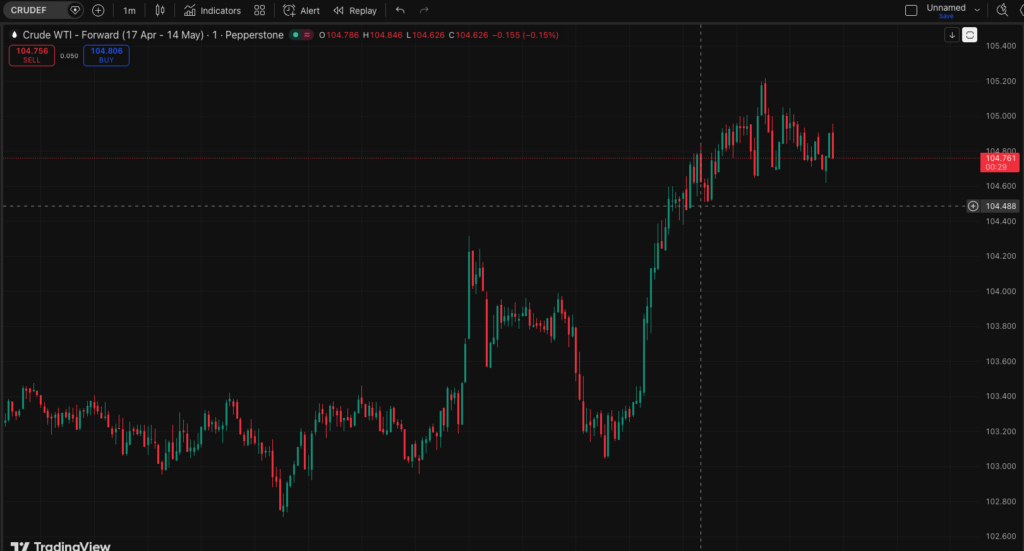
The chain effect is simple and brutal:
- Higher oil → higher inflation
- Higher inflation → fewer Fed rate cuts
- Fewer rate cuts → pressure on every tech stock reporting tonight
Why All Three Stories Are Actually One Story
Today’s market isn’t running three parallel narratives. It’s running one: can AI-driven tech valuations hold up against an inflationary macro environment?
The Magnificent Seven earnings answer the AI monetization half. Powell’s farewell Fed meeting answers the rate path half. And surging oil prices — driven by the Strait of Hormuz crisis and now the UAE’s OPEC exit — determine whether the Fed even has room to be dovish.
Bullish outcome: strong cloud growth, clear AI revenue, a neutral Fed tone, oil stabilizes → markets push toward new highs.
Bearish outcome: soft guidance, AI spend without proportional returns, a hawkish Powell, oil holds above $100 → sharp, broad sell-off.
Most likely outcome: significant volatility in both directions before a direction is established.
This Is Not a Normal Trading Session
When $12 trillion in market cap reports earnings on the same afternoon as a potentially historic Fed decision — while oil prices are being reshaped by a geopolitical war and a 60-year-old cartel fracturing in real time — you are not watching routine market news.
You’re watching the three dominant forces of 2026 markets — AI optimism, interest rate expectations, and geopolitical energy risk — collide at once.
Position accordingly.